
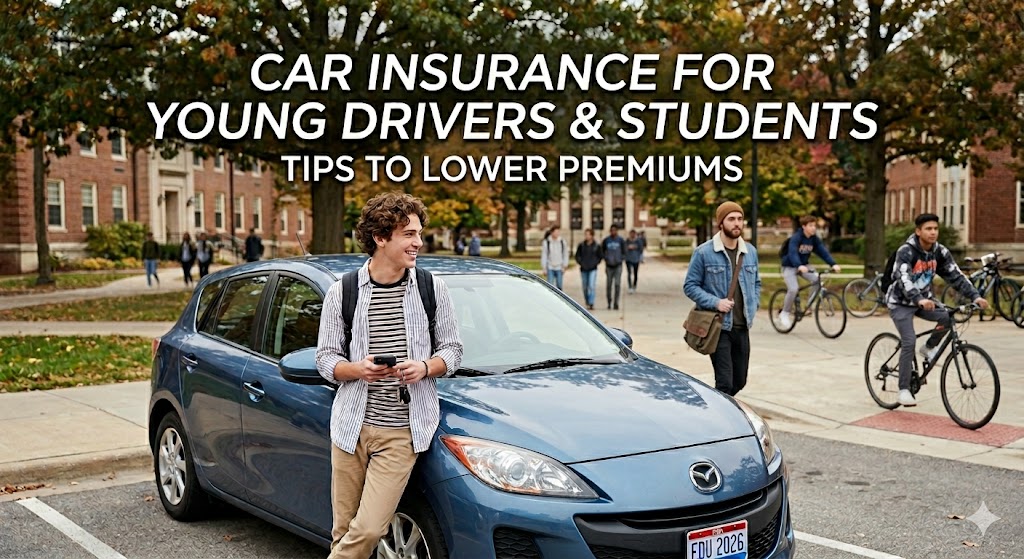
Car Insurance for Young Drivers and Students: Tips to Lower Premiums
Welcome to the ultimate guide for young drivers and students navigating the often-expensive world of American car insurance. If you’re under 25, you’ve probably noticed that your premium feels more like a monthly mortgage payment than a utility bill. You aren’t imagining it: statistically, younger drivers are a higher risk for insurance companies, and those companies price their policies accordingly.
However, being a student or a young professional doesn’t mean you have to break the bank. With the right strategy, a solid GPA, and a bit of “insurance literacy,” you can significantly slash those costs. This article explores how to find the best deals in 2026, which companies are leading the pack for students, and how you can use your status as a “Gen Z” or “Gen Alpha” driver to your financial advantage.
Florida Car Insurance Guide 2026: Why is it so Expensive and How to Save?
Why Is Car Insurance So Expensive for Young Drivers?
Before we dive into the savings, let’s address the elephant in the room: the price tag. In the U.S., the average cost for an 18-year-old on their own policy can soar above $6,000 per year.
Insurance is all about risk assessment. Actuarial data shows that drivers under 25 are more likely to be involved in accidents due to:
-
Inexperience: Lack of “road hours” makes it harder to anticipate hazards.
-
Risk-taking: Statistically, younger drivers are more prone to speeding or distracted driving.
-
The “Under 25” Threshold: For decades, 25 has been the “magic number” where rates typically begin to see a sharp decline, provided you have a clean record.
Car Insurance in the USA: 2026 Essential Guide to Coverage
Top Strategies to Lower Your Premiums
1. The “Good Student” Discount
This is the holy grail for high school and college students. Most major U.S. insurers offer a Good Student Discount if you maintain a certain academic standing.
-
The Requirement: Usually a 3.0 GPA (B average) or higher.
-
The Reward: Discounts ranging from 10% to 25% off your total premium.
-
Pro Tip: Keep your latest transcript handy; you’ll need to submit it annually to keep the discount active.
2. The “Student Away at School” Discount
Are you heading off to a university more than 100 miles away from home? If you’re leaving your car in the family garage, you can save a fortune.
-
How it works: Since you aren’t driving the car daily, the risk drops to near zero. Your parents can keep you on the policy for when you come home for the holidays, but at a fraction of the cost.
3. Telematics and “Pay-Per-Mile”
If you only drive to the grocery store or the library, why pay for a full-time policy?
-
Telematics (Usage-Based Insurance): Apps like State Farm’s Steer Clear or Progressive’s Snapshot track your driving habits. If you don’t speed and you avoid late-night driving, you can earn massive discounts.
-
Pay-Per-Mile: Companies like Allstate (with MileWise) allow you to pay a low base rate plus a few cents for every mile you actually drive.
4. Stay on the Family Policy
It is almost always cheaper to be an “additional driver” on your parents’ policy than to start your own. This allows you to benefit from their multi-car discounts and long-standing loyalty rewards.
Best Car Insurance Companies for Students (2026)
Choosing the right provider is half the battle. Here is a breakdown of the top U.S. insurers specializing in the student/young driver niche:
| Insurance Company | Best For… | Key Student Discounts | Typical GPA Requirement |
| State Farm | Overall Student Value | Up to 25% Good Student Discount; Steer Clear program. | 3.0 (B Average) |
| GEICO | Budget-Conscious | 15% Good Student Discount; Discounts for Greek Life & Honors Orgs. | 3.0 (B Average) |
| Allstate | Occasional Drivers | MileWise (Pay-per-mile); “Smart Student” discount. | 2.7+ (B- average) |
| Travelers | Away-at-School | Excellent “Student Away at School” rates for 100+ miles. | 3.0 (B Average) |
| USAA | Military Families | Lowest rates in the industry for ROTC and military legacy students. | 3.0 (B Average) |
| Progressive | Tech-Savvy Drivers | Snapshot program rewards safe habits immediately. | Average B |
Florida Truck Accident Laws 2026
Essential Coverage: What Do You Actually Need?
When you’re a student, it’s tempting to get “Minimum Liability” to save money. However, in a litigious society like the U.S., that can be a risky move. Here’s a balanced approach:
-
Liability Insurance: Required by law. It pays for the other person’s car and medical bills if you cause an accident. Recommendation: Go higher than the state minimum if you can afford it.
-
Collision & Comprehensive: If your car is an old “beater” worth less than $2,000, you might consider skipping these to save money. If you have a newer car or a loan, these are essential.
-
Uninsured Motorist Coverage: Protects you if someone hits you and they don’t have insurance (surprisingly common in many states).
Best Car Insurance in Texas 2026: Top Rates & Cheap Providers
Does my GPA really affect my car insurance?
Yes. Actuaries have found a statistical correlation between students who are responsible with their studies and students who are responsible on the road. Higher grades usually equal lower risk.
What happens to my insurance when I turn 25?
Usually, your rates will drop automatically. However, don’t wait for the insurance company to be generous—call your agent on your 25th birthday and ask for a re-rate to ensure you’re getting the “adult” price.
Can I get a discount for taking a defensive driving course?
Absolutely. Completing an AAA or National Safety Council-approved defensive driving course can often shave another 5-10% off your premium. It also helps remove points from your license if you’ve had a previous ticket.
If I get into an accident, will I lose my student discount?
You won’t lose the Good Student discount (as that is based on your grades), but you will likely lose your Good Driver or Accident-Free discount, and your base rate will likely increase.
Is “Pay-Per-Mile” worth it for college students?
If you live on campus and only use your car for the occasional weekend trip or grocery run, Pay-Per-Mile (like Allstate MileWise or Metromile) can save you hundreds of dollars compared to a traditional fixed policy.
The Bottom Line
Being a young driver in America is a rite of passage, but it shouldn’t be a financial burden. By maintaining your grades, choosing the right “niche” insurer, and taking advantage of telematics, you can drive with confidence without draining your savings account. Always remember to shop around every six months—as a young driver, your “risk profile” changes rapidly, and today’s best deal might be tomorrow’s overpriced policy.
Final Tip: If you’re a member of an honors society, a fraternity/sorority, or a professional student organization, always ask: “Do you offer a discount for members of [Organization Name]?” You’d be surprised how many “secret” discounts GEICO and Liberty Mutual have for specific student affiliations.
Leave a Reply